

From Santiago to Gaza, the unlikely alliance that proves football can carry a people.
by Lochlann de Brún“We don’t play just to win; we play to exist.”
Those were the words spoken by Ihab Abu Jazar, head coach of the Palestinian national football team, in the lead-up to an exhibition match in Bilbao against the Basque Country at the end of last year. The Palestinian team did not win in the packed-out San Mamés stadium, but its players, the opposing team and the 50,000 whose voices rose in solidarity with Palestine did affirm Abu Jazar’s words. Collectively, they expressed the proud existence of the Palestinian people, whom the Israeli government is so desperate to erase. On the pitch that night, football gave expression to struggle, grief, recognition and solidarity where politics has failed to do so. While the powerful figures that govern the world’s most adored sport dish out ‘peace awards’ to the powerful figures that have facilitated the genocide in Gaza, many ordinary people have turned to football as a means of standing up against the ongoing slaughter. Throughout Israel’s genocide in Gaza, symbols of Palestinian solidarity, like the match in Bilbao, have become one of the most important ways for people to express dissent against their own governments. The world has had to watch on as the death toll on the Gaza Strip exceeds 70,000, all whilst their own elected officials have either failed to act or have even actively aided in the daily slaughter of civilians. These symbols have become a means of expression that has allowed people to keep the genocide at the forefront of public consciousness, and football - with its badges, scarves, flags and enormous global stage - presents the perfect arena for that expression.
Throughout the genocide, one particular football shirt has stood out as one of the most recognisable symbols of Palestinian solidarity. It can be seen in footage of protests all over the world: climbing the Place de la République in Paris, crossing Westminster Bridge in London, or blockading Grand Central Terminal in New York. It can be seen worn casually in Ireland, on the streets of Belfast, Dublin and Cork. Sometimes (maybe more often in Ireland) the shirt appears as a curious amalgamation of Celtic FC and Palestine; the Glasgow club’s iconic green horizontal stripes are paired with the distinctive fishnet pattern of the keffiyeh, and it features the four-leafed clover crest that honours Celtic’s deep Irish roots. I had assumed that this was a football club based in Palestine, and maybe a Celtic fan with an eye for design had made a clever mashup available online. It was only several months later that I, by something of an accident, found myself at one of the club's matches. The stadium, however, was not in Bethlehem or in Ramallah, 8000 miles away from Palestine, in the Chilean capital of Santiago.
![]()
After a quick online search for ‘Palestine Celtic shirt’ I discovered that the jersey I had been seeing everywhere - with its Palestinian colours and emblems and its map of historical Palestine - was in fact Chilean. The shirt belongs to the Santiago-based football club, Club Deportivo Palestino, and its nod to Celtic was its third kit from 2024. As it happened, I was about to leave Ireland on an extended trip across South America. I decided that if I were to find myself in the Chilean capital, I would make it my mission to go to a Palestino match and find out more about this unusual connection between the two countries, so far apart both culturally and geographically. I also had to find out what the story was with the Celtic shirt. Without much surprise, midway through my travels, I did find myself in Santiago.
The South American metropolis lies in the centre of Neruda’s ‘thin country’, flanked by the towering Andes. A stroll down some of the central barrios reveals the distinctive, edgy and radical character of the city that can be seen in the rows of buildings adorned with tapestries of street art and political slogans. While some cities wear their heart on their sleeves, Santiago seems to wear it on its walls. It didn’t take long to get a glimpse of the steadfast Chilean support for Palestine; the vibrant Bellavista quarter had large murals in tribute to the children of Gaza and to Palestinian liberation. The barrio of Patranato was even more revealing. The streets had an array of Arabic cafes and clothes shops, and every second lamppost was flying a Palestinian flag. Some of the flags were fresh and new, while others, faded in colour, seemed to have been flying for years.
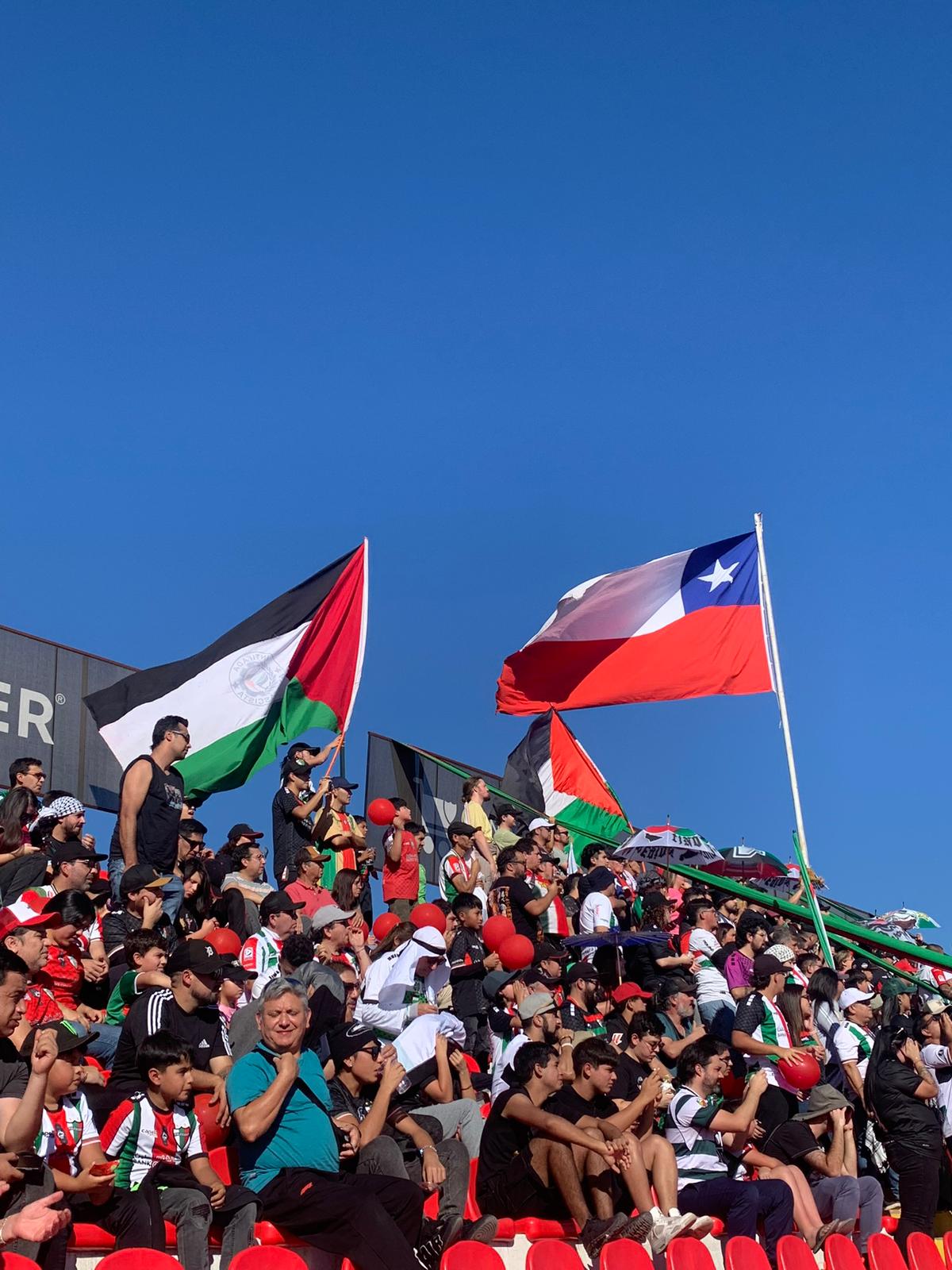
![]() I went to Palestino’s stadium, the Estadio Municipal de La Cisterna, to watch the club play Club Universidad de Chile. Above the main stand of the grounds, the Chilean flag flew proudly side by side proudly with the flag of Palestine. Amongst the passionate home fans in the stand were Palestino diehards in traditional Arabic thawbs and headdresses wearing the Celtic tribute shirt, looking a bit like a Unionist politician’s worst nightmare. Even the food stalls had swapped the classic Chilean completo hotdogs for shawarma and falafel. The Cisterna stadium felt like a living monument to the unlikely entanglement of these two cultures. After the match, I reached out to members of the Palestinian community to find out how it came to be that a football club in Chile had become an international symbol for Palestinian identity and resistance. I met with Valeria Apara Hizmeri (34), Palestino fan and social media manager of the Comunidad Palestina de Chile in the social sports club. Valeria’s great-grandfather had come to Chile from Palestine, and she can trace her family roots back to Bayt Jala, Bethlehem and Ein Karem, which became an Israeli settlement after the Nakba of 1948. The club itself was born of the waves of immigration to Chile that her own family was part of, and which led to Chile today having the largest Palestinian community outside of the Arab world. The South American country is home to an estimated 500,000 of Palestinian descent, with many residing in Santiago.
I went to Palestino’s stadium, the Estadio Municipal de La Cisterna, to watch the club play Club Universidad de Chile. Above the main stand of the grounds, the Chilean flag flew proudly side by side proudly with the flag of Palestine. Amongst the passionate home fans in the stand were Palestino diehards in traditional Arabic thawbs and headdresses wearing the Celtic tribute shirt, looking a bit like a Unionist politician’s worst nightmare. Even the food stalls had swapped the classic Chilean completo hotdogs for shawarma and falafel. The Cisterna stadium felt like a living monument to the unlikely entanglement of these two cultures. After the match, I reached out to members of the Palestinian community to find out how it came to be that a football club in Chile had become an international symbol for Palestinian identity and resistance. I met with Valeria Apara Hizmeri (34), Palestino fan and social media manager of the Comunidad Palestina de Chile in the social sports club. Valeria’s great-grandfather had come to Chile from Palestine, and she can trace her family roots back to Bayt Jala, Bethlehem and Ein Karem, which became an Israeli settlement after the Nakba of 1948. The club itself was born of the waves of immigration to Chile that her own family was part of, and which led to Chile today having the largest Palestinian community outside of the Arab world. The South American country is home to an estimated 500,000 of Palestinian descent, with many residing in Santiago.
 CD Palestino playing at Estadio Municipal de La Cisterna in Santiago (from CD Palestino)
“The immigration started before 1900, a little before that the first family started to come here. And then in 1910 a lot of people came. Initially, the people that came were from Bayt Jala, Bethlehem and Beit Sahour. There were Christian families in that time, Palestine was dominated by the Ottoman Empire, and the First World War had begun. The Ottomans said to the Christian families that they have to give their child to go to fight for Turkey and many families were afraid, and they didn't want to, and so they started to move to other countries.”
“One of the common routes was starting in the port of Haifa [now part of the state of Israel] and they went to Europe, to Napoli or Marseilles, for example. And then they went straight to Buenos Aires. They caught the train to Mendoza, which is a city near Santiago, but on the other side of the Andes, and they came by donkey to Santiago, over the Andes. Then they started to go to different parts of Chile, to the north of Chile, to the south, while others stayed in Santiago. And that's why, because they wanted to look for more opportunities to work. They used to work in textiles, in clothes, and that was not very big here in Chile. So they started to buy things like materials and go to the south to sell them. So the Palestinian people always looked for a way to continue their way of living.”
Explaining the complex multi-stop journey of the Palestinians' arrival in Chile, crossing continents and mountain ranges, Valeria remembers a joke from her father: “My father has a joke - he says that the price of the ship was the same if you went to the first stop or to the last stop, and because they were Arabs, they wanted to take advantage of the ticket and go to the last…this is a joke, okay? But the truth is, Chile was a land with more opportunities, and was not so developed. It was a starting country. Palestinian people are also very close to their families. So when they came here, it started with the first one, and then they brought another one, and then they brought the fathers, and then they brought their grandfathers. So I think that's why the community became concentrated here in Chile.”

 Valeria Apara Hizmeri
While the first wave of Palestinians arrived in the early 20th Century, seismic events of ethnic cleansing following the establishment of the Israeli state in 1948, meant that Palestinians continued to arrive in Chile in large numbers and join the growing community there.
“The second wave came at the establishment of the state of Israel, when 700,000 Palestinians were displaced from their homes and forced to leave their land. So there were a lot of people that went to Jordan first. In 1948 in the register of Chile, you can see there were a lot of Jordanian people coming here to Chile, but they weren't Jordanian people. They were stateless Palestinians with Jordanian passports.”
“The next wave was in the Naksa in 1967 in the Six-Day War, there was another big displacement of Palestinian people from their villages [around 300,000]. Then, in the beginning of the 2000s, more came as refugees, invited by the government, and now, with the genocide, we know that some more families have come.”
Throughout those waves of migration and displacement, Club Deportivo Palestino was established and became a beacon for the Palestinian community in Santiago. It was founded in 1920 and gradually became one of the most popular clubs in Chile, attracting immigrants and Chileans alike. Since their foundation, they have won Two First Division titles, three Chilean Cups, and two Second Division titles.
The club itself is testament to what football at its very purest can represent, something that is perfectly captured by its motto: “Palestino has a motto in Spanish: Mas que un equipo, todo un pueblo! [More than a team, an entire people!] You know that is the slogan of Palestino, because it’s not just a football team, it is a team that represents the Palestinian cause. Every time they go to play in other countries, they go with the Palestinian flag. So everyone here in Chile of the Palestinian community, almost all of them support Palestino, or Palestino is their second team.”

CD Palestino players wearing the keffiyeh (from CD Palestino)
It is that exact cause which has made the shirt an international symbol that has resonated throughout the world. On the club’s jersey becoming a symbol, Valeria said: “When we see images of the marches in other countries, in France, in England, there always appears a person with the Palestino shirt. It is not only a shirt of a football team, it is like a symbol of resistance. If you look at it closely it pays homage to the Palestinian cause and identity in lots of ways; the colour of the flag, the map - the historic map, the coffee. This year Palestino has a new shirt designed like a watermelon, and it's so beautiful. The watermelon started [to be used symbolically] in the Intifada when Israel prohibited the Palestinian flag. So the Palestinian people, to represent the Palestinian flag, they started using the watermelon.”
The strength of the club as a community and the symbolic resonance of the shirt has created unlikely bonds the world over - most notably in the now-iconic Celtic tribute shirt: “When the genocide started, the people here in Chile and the directors of Palestino started to see that the Celtic fans give a lot of support to Palestine, not only in the games there in Scotland, but also in the place against Israeli teams and in the Champions League - that was huge! They didn't care about the economic fines. They always continue supporting Palestine and that's why last year Palestino said, Okay, we're gonna have a shirt. This is going to be our third shirt in honor to the people of Celtic and the Celtic fans, because they are the most supportive fans of a football team in the world, to Palestine. That shirt is really popular here in Chile.”

CD Palestino players in the 2024 Celtic-inspired kit (from CD Palestino)
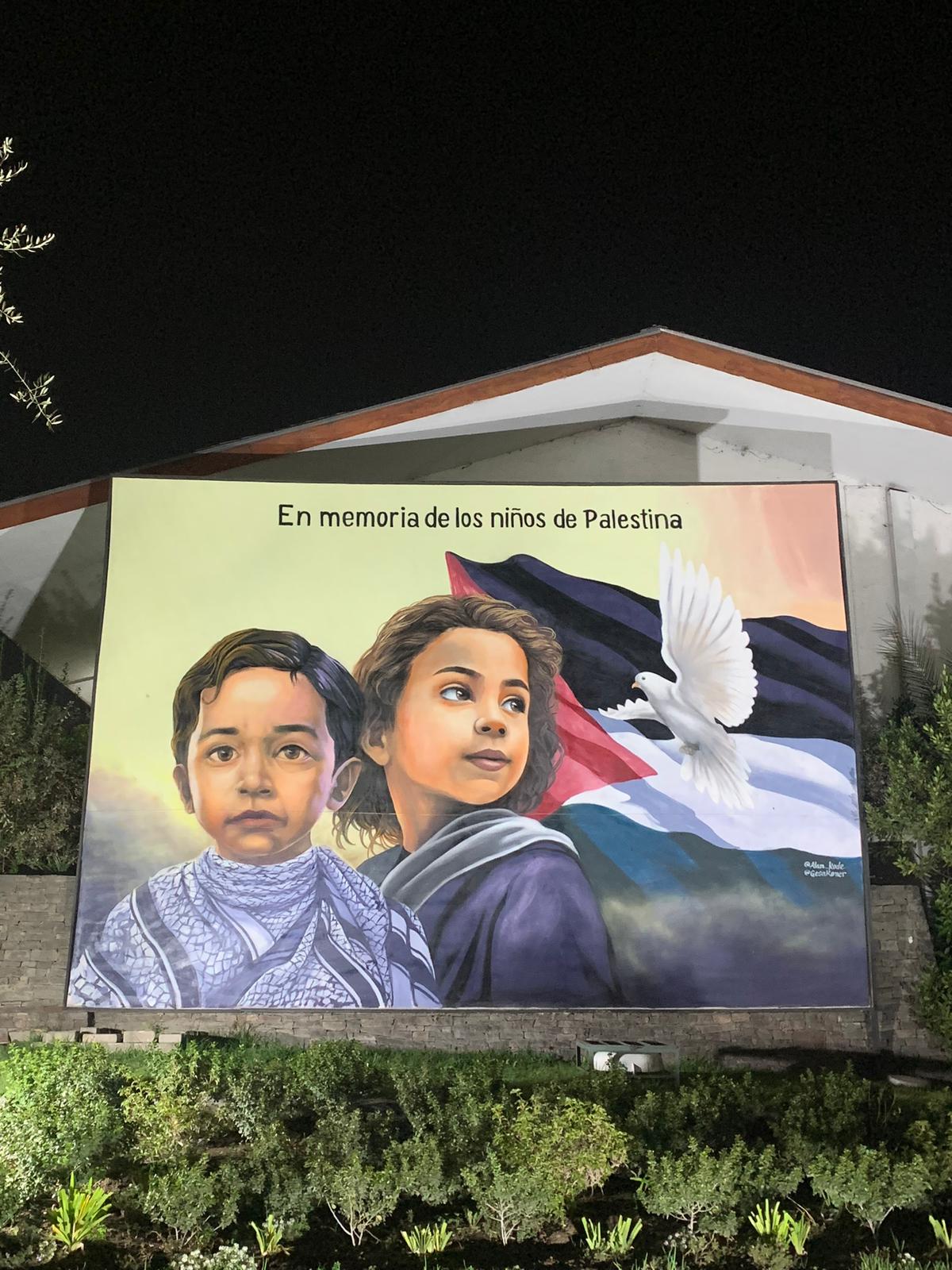
Israel’s genocide in Gaza has had a profound impact on the club and on the wider Palestinian community in Chile. The social club exhibits proud mementoes of the club’s history, but amongst them are reminders of the sustained slaughter of civilians taking place in the club’s heartland. Outside is a huge mural with two Palestinian children, the flag and a white dove behind them. Above them, written: En memoria de los niños de Palestina [In memory of the children of Palestine]
On average, Israel has killed 28 children in Palestine every day for the last two years.
![]()
“There is immense sadness and frustration because a lot of people here continue having people over there too. For example, I have my own people living there. So it's caring like, who in your family is still there?
The community here is really sad, but I think some parts of the community still have hope, because this waking up, that things are gonna start changing. Okay, some people are more negative and think this is not going to end. But the positive thing is that some people of the community that are of Palestinian descent, maybe, second, third, or even fourth generation that were really assimilated with Chilean people, they start to say, Oh, I'm Palestinian - now I have to work for Palestine. They weren't working for the cause before, and now they have this awakening.”
I asked Valeria if she had a parting message to Ireland, where the Palestino shirt is so popular and where ordinary people have made their support for Palestine loud and clear:
“I want to say that I love the people of Ireland! I know that you have a struggle really similar to us about your freedom, about your traditions, about preserving what you really are. We have a similar struggle and I am really grateful to the Irish people, and also to the Celtic fans because they weren’t scared about all the people in the world, or UEFA who said ‘you can’t do this, you can’t do that!’ They continue to support Palestine, and I will ask them not to stop in their support of Palestine until Palestine is free.”
The need to nurture the connection with Palestine finds many other outlets beyond football, as Omar Salameh (32) explained when I spoke with him outside the social club. A Palestino fan and third generation Palestinian, Omar works as a lawyer, but he also teaches dabke, a traditional Palestinian and Levantian dance, as well as tatreez, traditional Palestinian embroidery. Showing me images of an array of tatreez and the symbolic importance of certain stitches, he explained to me why he thinks it is important to teach the art and culture of his heritage:
“I think it's necessary to preserve our culture, especially for Palestinians that we've been living in the diaspora or in exile for generations. So the new generations need to connect with Palestine through our traditions. Maybe you're Palestinian, born in Chile, for example, and you never visited Palestine. So this is the way that you can connect with those traditions and not to forget our origins and our culture.”
“It's resistance, because just to exist and just to preserve our traditions, this resistance, this is like a message for the world, okay, we are Palestinians. These are our traditions, and we are here, and we are not going anywhere. I don't care how many generations have passed, I'm Palestinian. It's part of my identity. We have strong traditions and identity that the colonial settlers cannot erase.”
For Omar, Palestino Deportivo isn’t just important as a means to show those traditions and identity exist and are strong today, but that they have been there for many years:
“For me, Palestino is like living proof that we were in Palestine long before the Israeli state. [The club] was established in 1920, years before the operation of the State of Israel [1948]. In Chile, in the other extreme of the world, we have a First Division football team that was established 30 years before Israel. So, for me it's very important, because we are also victims of negotiation.”
As the club’s motto proclaims, Palestino is about much more than football. It is an entire community bonded together through their shared culture, their shared history of exile and their shared wish for their people to be free. For years, Chile was a frontrunner in Latin American politics in terms of recognising Palestine, and in recent years in condemning Israel’s genocide in Gaza; however, that could be set to change. With the election of far-right President José Antonio Kast, Chile joins Argentina, Ecuador and Paraguay in the South American shift towards the right, and towards leaders that are pro-privatisation and staunchly pro-Israel. Kast’s own ardent support of Israel is all the more curious considering his father, a German immigrant to Chile, was a member of the Nazi party. Despite this possible looming change in national policy towards Israel, the Palestinian community in Chile represents a flourishing resistance to those attempts to erase a people and their culture. For over a century, the diaspora has expressed its roots and kept them growing in whatever way it can. Football chants belted out with arms linked tight across shoulders, fine coloured threads weaved firm into tatreez tapestry; these bonds form and maintain a community that stands together with incredible resilience - one that refuses to be cast out. They can inspire in Chile, in Ireland, or anywhere else in the world. Palestino is a shining symbol of the power that community and culture can have. A reminder that while the wanton boys in power try to kill for their sport, a people can come together and play to resist.
Throughout the genocide, one particular football shirt has stood out as one of the most recognisable symbols of Palestinian solidarity. It can be seen in footage of protests all over the world: climbing the Place de la République in Paris, crossing Westminster Bridge in London, or blockading Grand Central Terminal in New York. It can be seen worn casually in Ireland, on the streets of Belfast, Dublin and Cork. Sometimes (maybe more often in Ireland) the shirt appears as a curious amalgamation of Celtic FC and Palestine; the Glasgow club’s iconic green horizontal stripes are paired with the distinctive fishnet pattern of the keffiyeh, and it features the four-leafed clover crest that honours Celtic’s deep Irish roots. I had assumed that this was a football club based in Palestine, and maybe a Celtic fan with an eye for design had made a clever mashup available online. It was only several months later that I, by something of an accident, found myself at one of the club's matches. The stadium, however, was not in Bethlehem or in Ramallah, 8000 miles away from Palestine, in the Chilean capital of Santiago.
After a quick online search for ‘Palestine Celtic shirt’ I discovered that the jersey I had been seeing everywhere - with its Palestinian colours and emblems and its map of historical Palestine - was in fact Chilean. The shirt belongs to the Santiago-based football club, Club Deportivo Palestino, and its nod to Celtic was its third kit from 2024. As it happened, I was about to leave Ireland on an extended trip across South America. I decided that if I were to find myself in the Chilean capital, I would make it my mission to go to a Palestino match and find out more about this unusual connection between the two countries, so far apart both culturally and geographically. I also had to find out what the story was with the Celtic shirt. Without much surprise, midway through my travels, I did find myself in Santiago.
The South American metropolis lies in the centre of Neruda’s ‘thin country’, flanked by the towering Andes. A stroll down some of the central barrios reveals the distinctive, edgy and radical character of the city that can be seen in the rows of buildings adorned with tapestries of street art and political slogans. While some cities wear their heart on their sleeves, Santiago seems to wear it on its walls. It didn’t take long to get a glimpse of the steadfast Chilean support for Palestine; the vibrant Bellavista quarter had large murals in tribute to the children of Gaza and to Palestinian liberation. The barrio of Patranato was even more revealing. The streets had an array of Arabic cafes and clothes shops, and every second lamppost was flying a Palestinian flag. Some of the flags were fresh and new, while others, faded in colour, seemed to have been flying for years.
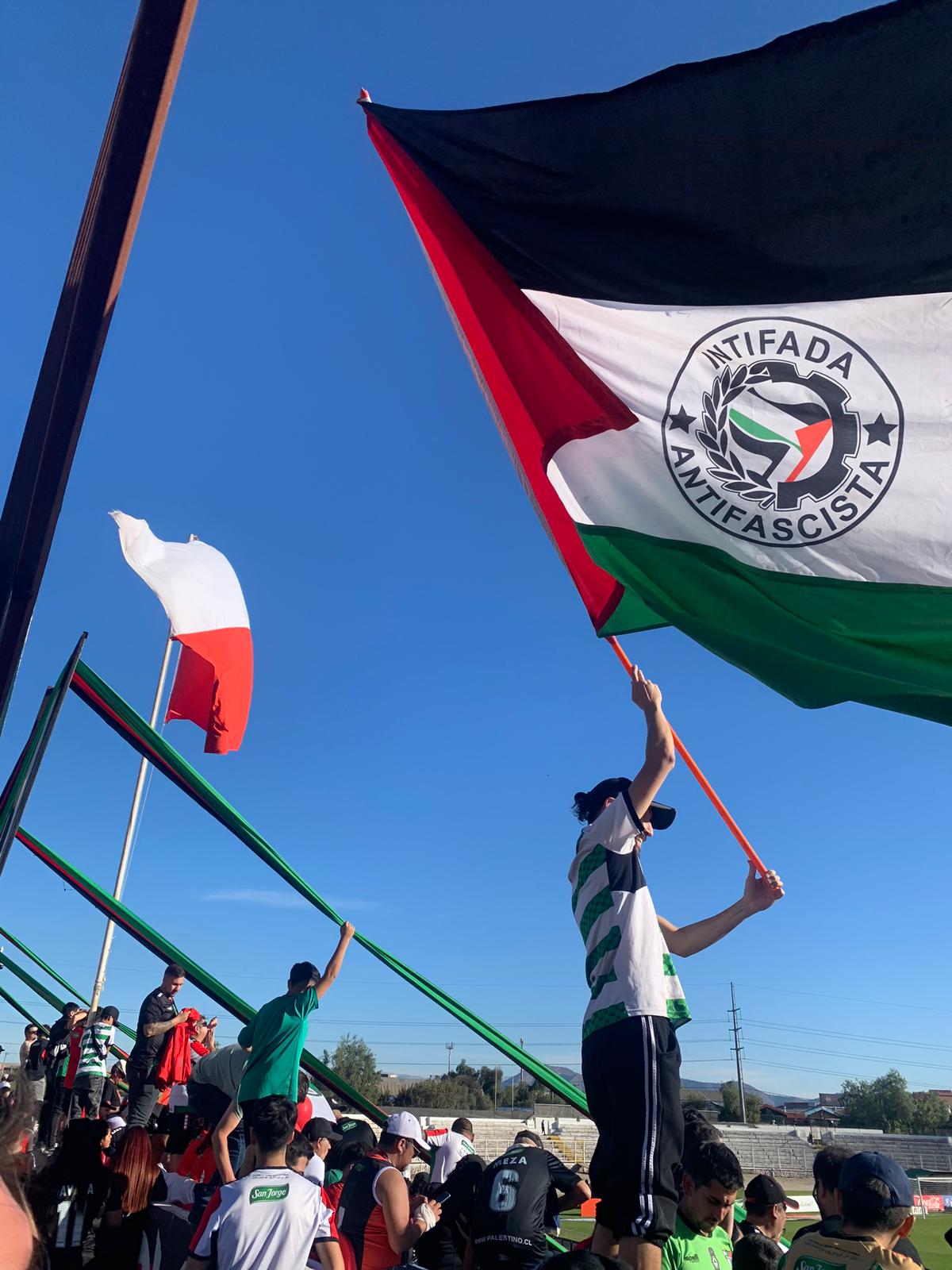 I went to Palestino’s stadium, the Estadio Municipal de La Cisterna, to watch the club play Club Universidad de Chile. Above the main stand of the grounds, the Chilean flag flew proudly side by side proudly with the flag of Palestine. Amongst the passionate home fans in the stand were Palestino diehards in traditional Arabic thawbs and headdresses wearing the Celtic tribute shirt, looking a bit like a Unionist politician’s worst nightmare. Even the food stalls had swapped the classic Chilean completo hotdogs for shawarma and falafel. The Cisterna stadium felt like a living monument to the unlikely entanglement of these two cultures. After the match, I reached out to members of the Palestinian community to find out how it came to be that a football club in Chile had become an international symbol for Palestinian identity and resistance. I met with Valeria Apara Hizmeri (34), Palestino fan and social media manager of the Comunidad Palestina de Chile in the social sports club. Valeria’s great-grandfather had come to Chile from Palestine, and she can trace her family roots back to Bayt Jala, Bethlehem and Ein Karem, which became an Israeli settlement after the Nakba of 1948. The club itself was born of the waves of immigration to Chile that her own family was part of, and which led to Chile today having the largest Palestinian community outside of the Arab world. The South American country is home to an estimated 500,000 of Palestinian descent, with many residing in Santiago.
“The immigration started before 1900, a little before that the first family started to come here. And then in 1910 a lot of people came. Initially, the people that came were from Bayt Jala, Bethlehem and Beit Sahour. There were Christian families in that time, Palestine was dominated by the Ottoman Empire, and the First World War had begun. The Ottomans said to the Christian families that they have to give their child to go to fight for Turkey and many families were afraid, and they didn't want to, and so they started to move to other countries.”
“One of the common routes was starting in the port of Haifa [now part of the state of Israel] and they went to Europe, to Napoli or Marseilles, for example. And then they went straight to Buenos Aires. They caught the train to Mendoza, which is a city near Santiago, but on the other side of the Andes, and they came by donkey to Santiago, over the Andes. Then they started to go to different parts of Chile, to the north of Chile, to the south, while others stayed in Santiago. And that's why, because they wanted to look for more opportunities to work. They used to work in textiles, in clothes, and that was not very big here in Chile. So they started to buy things like materials and go to the south to sell them. So the Palestinian people always looked for a way to continue their way of living.”
Explaining the complex multi-stop journey of the Palestinians' arrival in Chile, crossing continents and mountain ranges, Valeria remembers a joke from her father: “My father has a joke - he says that the price of the ship was the same if you went to the first stop or to the last stop, and because they were Arabs, they wanted to take advantage of the ticket and go to the last…this is a joke, okay? But the truth is, Chile was a land with more opportunities, and was not so developed. It was a starting country. Palestinian people are also very close to their families. So when they came here, it started with the first one, and then they brought another one, and then they brought the fathers, and then they brought their grandfathers. So I think that's why the community became concentrated here in Chile.”
Valeria Apara HizmeriWhile the first wave of Palestinians arrived in the early 20th Century, seismic events of ethnic cleansing following the establishment of the Israeli state in 1948, meant that Palestinians continued to arrive in Chile in large numbers and join the growing community there.
“The second wave came at the establishment of the state of Israel, when 700,000 Palestinians were displaced from their homes and forced to leave their land. So there were a lot of people that went to Jordan first. In 1948 in the register of Chile, you can see there were a lot of Jordanian people coming here to Chile, but they weren't Jordanian people. They were stateless Palestinians with Jordanian passports.”
“The next wave was in the Naksa in 1967 in the Six-Day War, there was another big displacement of Palestinian people from their villages [around 300,000]. Then, in the beginning of the 2000s, more came as refugees, invited by the government, and now, with the genocide, we know that some more families have come.”
Throughout those waves of migration and displacement, Club Deportivo Palestino was established and became a beacon for the Palestinian community in Santiago. It was founded in 1920 and gradually became one of the most popular clubs in Chile, attracting immigrants and Chileans alike. Since their foundation, they have won Two First Division titles, three Chilean Cups, and two Second Division titles.
The club itself is testament to what football at its very purest can represent, something that is perfectly captured by its motto: “Palestino has a motto in Spanish: Mas que un equipo, todo un pueblo! [More than a team, an entire people!] You know that is the slogan of Palestino, because it’s not just a football team, it is a team that represents the Palestinian cause. Every time they go to play in other countries, they go with the Palestinian flag. So everyone here in Chile of the Palestinian community, almost all of them support Palestino, or Palestino is their second team.”
CD Palestino players wearing the keffiyeh (from CD Palestino)
It is that exact cause which has made the shirt an international symbol that has resonated throughout the world. On the club’s jersey becoming a symbol, Valeria said: “When we see images of the marches in other countries, in France, in England, there always appears a person with the Palestino shirt. It is not only a shirt of a football team, it is like a symbol of resistance. If you look at it closely it pays homage to the Palestinian cause and identity in lots of ways; the colour of the flag, the map - the historic map, the coffee. This year Palestino has a new shirt designed like a watermelon, and it's so beautiful. The watermelon started [to be used symbolically] in the Intifada when Israel prohibited the Palestinian flag. So the Palestinian people, to represent the Palestinian flag, they started using the watermelon.”
The strength of the club as a community and the symbolic resonance of the shirt has created unlikely bonds the world over - most notably in the now-iconic Celtic tribute shirt: “When the genocide started, the people here in Chile and the directors of Palestino started to see that the Celtic fans give a lot of support to Palestine, not only in the games there in Scotland, but also in the place against Israeli teams and in the Champions League - that was huge! They didn't care about the economic fines. They always continue supporting Palestine and that's why last year Palestino said, Okay, we're gonna have a shirt. This is going to be our third shirt in honor to the people of Celtic and the Celtic fans, because they are the most supportive fans of a football team in the world, to Palestine. That shirt is really popular here in Chile.”
CD Palestino players in the 2024 Celtic-inspired kit (from CD Palestino)
Israel’s genocide in Gaza has had a profound impact on the club and on the wider Palestinian community in Chile. The social club exhibits proud mementoes of the club’s history, but amongst them are reminders of the sustained slaughter of civilians taking place in the club’s heartland. Outside is a huge mural with two Palestinian children, the flag and a white dove behind them. Above them, written: En memoria de los niños de Palestina [In memory of the children of Palestine]
On average, Israel has killed 28 children in Palestine every day for the last two years.
“There is immense sadness and frustration because a lot of people here continue having people over there too. For example, I have my own people living there. So it's caring like, who in your family is still there?
The community here is really sad, but I think some parts of the community still have hope, because this waking up, that things are gonna start changing. Okay, some people are more negative and think this is not going to end. But the positive thing is that some people of the community that are of Palestinian descent, maybe, second, third, or even fourth generation that were really assimilated with Chilean people, they start to say, Oh, I'm Palestinian - now I have to work for Palestine. They weren't working for the cause before, and now they have this awakening.”
I asked Valeria if she had a parting message to Ireland, where the Palestino shirt is so popular and where ordinary people have made their support for Palestine loud and clear:
“I want to say that I love the people of Ireland! I know that you have a struggle really similar to us about your freedom, about your traditions, about preserving what you really are. We have a similar struggle and I am really grateful to the Irish people, and also to the Celtic fans because they weren’t scared about all the people in the world, or UEFA who said ‘you can’t do this, you can’t do that!’ They continue to support Palestine, and I will ask them not to stop in their support of Palestine until Palestine is free.”
The need to nurture the connection with Palestine finds many other outlets beyond football, as Omar Salameh (32) explained when I spoke with him outside the social club. A Palestino fan and third generation Palestinian, Omar works as a lawyer, but he also teaches dabke, a traditional Palestinian and Levantian dance, as well as tatreez, traditional Palestinian embroidery. Showing me images of an array of tatreez and the symbolic importance of certain stitches, he explained to me why he thinks it is important to teach the art and culture of his heritage:
“I think it's necessary to preserve our culture, especially for Palestinians that we've been living in the diaspora or in exile for generations. So the new generations need to connect with Palestine through our traditions. Maybe you're Palestinian, born in Chile, for example, and you never visited Palestine. So this is the way that you can connect with those traditions and not to forget our origins and our culture.”
“It's resistance, because just to exist and just to preserve our traditions, this resistance, this is like a message for the world, okay, we are Palestinians. These are our traditions, and we are here, and we are not going anywhere. I don't care how many generations have passed, I'm Palestinian. It's part of my identity. We have strong traditions and identity that the colonial settlers cannot erase.”
For Omar, Palestino Deportivo isn’t just important as a means to show those traditions and identity exist and are strong today, but that they have been there for many years:
“For me, Palestino is like living proof that we were in Palestine long before the Israeli state. [The club] was established in 1920, years before the operation of the State of Israel [1948]. In Chile, in the other extreme of the world, we have a First Division football team that was established 30 years before Israel. So, for me it's very important, because we are also victims of negotiation.”
As the club’s motto proclaims, Palestino is about much more than football. It is an entire community bonded together through their shared culture, their shared history of exile and their shared wish for their people to be free. For years, Chile was a frontrunner in Latin American politics in terms of recognising Palestine, and in recent years in condemning Israel’s genocide in Gaza; however, that could be set to change. With the election of far-right President José Antonio Kast, Chile joins Argentina, Ecuador and Paraguay in the South American shift towards the right, and towards leaders that are pro-privatisation and staunchly pro-Israel. Kast’s own ardent support of Israel is all the more curious considering his father, a German immigrant to Chile, was a member of the Nazi party. Despite this possible looming change in national policy towards Israel, the Palestinian community in Chile represents a flourishing resistance to those attempts to erase a people and their culture. For over a century, the diaspora has expressed its roots and kept them growing in whatever way it can. Football chants belted out with arms linked tight across shoulders, fine coloured threads weaved firm into tatreez tapestry; these bonds form and maintain a community that stands together with incredible resilience - one that refuses to be cast out. They can inspire in Chile, in Ireland, or anywhere else in the world. Palestino is a shining symbol of the power that community and culture can have. A reminder that while the wanton boys in power try to kill for their sport, a people can come together and play to resist.